Problem 1: Guided practice
Find the mean, total distance, and MAD for 3, 5, 7, 9.
Show step-by-step solution
The mean is (3 + 5 + 7 + 9) ÷ 4 = 6. The distances are 3, 1, 1, and 3. Their sum is 8. MAD = 8 ÷ 4 = 2.
LEARN IT. TRY IT. CHECK YOUR WORK.
Learn to find the mean absolute deviation of a data set, one step at a time. Then check your understanding with four practice problems.
Here, MAD means mean absolute deviation. Median absolute deviation is a different measure; this lesson uses the mean.
01 / THE BIG IDEA
Find the mean, find each number’s distance from the mean, then average those distances. That final average is your MAD. Think “average distance,” not “biggest distance.”
Mean is another word for average. Add the data values and divide by the number of values. For 6 and 10, the mean is 8.
Deviation is the difference between a value and the mean. Six is two below eight, so its deviation is −2. Ten is two above eight, so its deviation is +2.
Absolute tells you to use the distance without a negative sign. Both numbers are two units from eight: |−2| = 2 and |2| = 2. The vertical bars mean absolute value, not parentheses.
MAD describes how spread out the data are around their mean. When the distances are small, the values sit close to that center. You will use every value, including repeats.
Imagine placing the numbers on a number line. The mean gives you a meeting point, and each distance tells you how far a number would travel to reach it. MAD averages those trips. It combines all the distances into one useful description without listing every value again.
02 / READ THE SYMBOLS
MAD = total distance from the mean ÷ number of values
The symbols shorten the same instructions. Use this reference with the example 6, 8, 10, 12, whose mean is 9.
| Symbol | Read it as | Example |
|---|---|---|
| MAD | The average distance; your answer. | 2 minutes |
| xᵢ | One value in the data set. | 6, 8, 10, or 12 |
| i | A position label, not multiplication. | x₁ = 6; x₂ = 8 |
| x̄ | “X-bar,” the mean. | 9 |
| − | Subtract the mean from a value. | 6 − 9 = −3 |
| | | | Take the absolute value: distance. | |−3| = 3 |
| Σ | “Sigma”: add the distances. | 3 + 1 + 1 + 3 = 8 |
| n | How many values there are. | 4 values, not their sum |
| / | Divide; a fraction bar means the same thing. | 8 ÷ 4 = 2 |
You do not need to memorize sigma to solve the problem. Follow the operations in order: subtract, take absolute values, add, and divide.
03 / FOLLOW A COMPLETE EXAMPLE
Four students read for 6, 8, 10, and 12 minutes. What is the mean absolute deviation of their reading times? Write down the four values before you start.
Add the reading times: 6 + 8 + 10 + 12 = 36. Divide by the number of students: 36 ÷ 4 = 9 minutes. All the distances in the next step must be measured from 9.
Notice that 9 is not one of the original reading times. That is fine: a mean does not have to appear in the data. Also, count four students, not the numbers from six through twelve. There are four observations because four reading times were recorded.
Subtract 9 from each value, then take its absolute value. Keep the signed differences and distances in separate columns so you can see what changes.
| Time | Difference from 9 | Absolute distance |
|---|---|---|
| 6 | 6 − 9 = −3 | 3 |
| 8 | 8 − 9 = −1 | 1 |
| 10 | 10 − 9 = 1 | 1 |
| 12 | 12 − 9 = 3 | 3 |
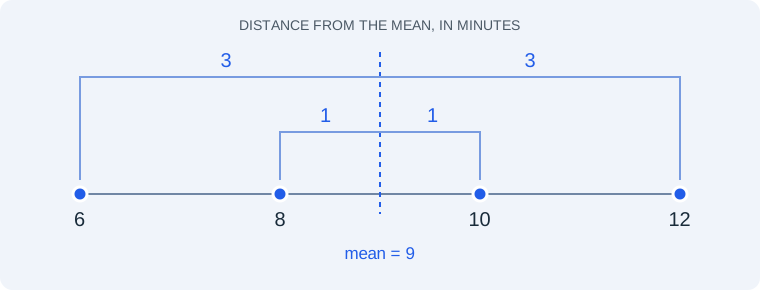
Add the last column: 3 + 1 + 1 + 3 = 8. Divide by four: MAD = 8 ÷ 4 = 2 minutes.
Explain your answer: “The reading times are 2 minutes from the mean, on average.” It does not mean every student’s time is exactly two minutes away.
Use the MAD calculator to compare your distance column with its breakdown.
For 2, 3, 4, the mean is (2 + 3 + 4) ÷ 3 = 3. The distances are |2 − 3| = 1, |3 − 3| = 0, and |4 − 3| = 1.
Their sum is 2, so MAD = 2 ÷ 3 = 2/3 ≈ 0.67. The ≈ sign means “approximately.” Round to the nearest hundredth only at the end.
Still divide by three. A zero distance belongs to a real data value; it does not disappear from the count.
MAD uses the same units as your data. A smaller value means less spread, not necessarily a better result. Compare data in matching units and context.
As a quick reasonableness check, your answer cannot be negative or greater than the largest absolute distance. In the reading example, the largest distance is three minutes, so an answer of eight minutes cannot be the MAD. Eight is the distance total; you still need to divide it by four.
04 / YOUR TURN
Work on paper first. Check each part of Problem 1, then try the others on your own. Enter numbers without units; use decimals rather than fractions. You can retry or open a solution at any time.
For each problem, make three columns on paper: value, difference from the mean, and absolute distance. Before opening the solution, write one sentence explaining your final answer. If a check says “Not quite,” keep your work and look for the first step where your numbers disagree with the solution.
Find the mean, total distance, and MAD for 3, 5, 7, 9.
The mean is (3 + 5 + 7 + 9) ÷ 4 = 6. The distances are 3, 1, 1, and 3. Their sum is 8. MAD = 8 ÷ 4 = 2.
Find MAD for 4, 4, 6, 6. Count both copies of each number.
The mean is (4 + 4 + 6 + 6) ÷ 4 = 5. The distances are 1, 1, 1, and 1, totaling 4. MAD = 4 ÷ 4 = 1.
Find MAD for 2, 4, 5. Round your final answer to two decimal places.
The mean is (2 + 4 + 5) ÷ 3 = 11/3. The distances are 5/3, 1/3, and 4/3. Their sum is 10/3. Divide by three again: MAD = (10/3) ÷ 3 = 10/9 ≈ 1.11.
Find MAD for 8, 8, 8, 8. Think about where each value sits relative to the mean.
The mean is (8 + 8 + 8 + 8) ÷ 4 = 8. Every distance is 0, so their sum is 0. MAD = 0 ÷ 4 = 0. There is no spread.
Compare this with Problem 2: repeated values alone do not guarantee zero MAD. The values must all equal the same number. Two fours and two sixes still sit on opposite sides of their mean, so they have a nonzero average distance.
No. Order does not change the mean or the sum of distances. Keep the original order if it helps you match your table to the question.
Use it twice. Each entry represents an observation. Removing repeats changes the data set and can change the answer.
Yes. That value is its own mean, its distance is zero, and its MAD is zero. An empty list is different: there is no mean to calculate.
Compare your mean and each distance before comparing final answers. If those match, check the last addition and division. Be sure you selected mean mode, not median mode.
Once you find an error, close the solution and try that step again without looking. Then explain why the corrected operation works. Being able to say “I divide by the number of distances because I am finding their average” is more useful than remembering an answer.
Ready for your own data? Open the MAD calculator, enter your numbers, and use its breakdown to check the method you just learned.